
Learning Cultures
- Dec 9, 2025
- 6 min read

A busy U.S. teaching hospital unit was tracking a high number of potentially life-threatening errors.
They were recording 23.7 errors per 1,000 patent days when administering drugs .
The nurse manager spotted wearing blood-stained scrubs.
She was spending the majority of her time nursing and only about a third of her time managing the unit.
She seemed comfortable with error, saying that a “certain level of error will occur.”
And she’d created a "non-punitive environment” within the team.
One of her nurses said, “there is no punishment: you just let the doctor know and fill out an incident report.”
In another part of the same hospital a second unit was functioning with extremely low levels of error.
They had a detected error rate of 2.3 - just one tenth of the other unit’s.
The nurse manager of this unit dressed impeccably in a business suit.
Her unit “prides itself on being clean, neat and having the appearance of professionalism.”
She was focused almost exclusively on managing, only nursing ten per cent of her time.
At first glance, and on paper, the second unit was the star performer.
But when researchers dug a little deeper they discovered a very different story.
The first unit had a very collaborative and open learning culture, where the physicians are “respectful of nurses’ expertise.”
The nurse manager, being very hands on, was always available to help and support her team.
A nurse on the unit said that there is an “unspoken rule here to help each other and check each other.”
And the team was very honest if any mistakes were made.
Another nurse in the team said that “people feel more willing to admit errors here, because [the nurse manager] goes to bat for you.”
This culture was actively catching problems before they occurred:
In one situation a nurse noticed that an order of medication was too high, so she called the doctor who confirmed her concern and agreed to cut the dose in half.
A potentially serious outcome was averted.
Meanwhile in the second unit when a mistake is made, “you get in trouble."
The unit "doesn't support nurses; doctors condescend, and they bite your head off if you make a mistake.”
The nurse manager operated from within the walls of her office and ran a hierarchical team.
When one nurse made a mistake, she felt like she was “on trial; it was degrading, like I was a two-year old.”
There was a very serious culture of blame within the unit and it was affecting patient safety.
The first unit was functioning extremely well as a team and the second unit was dysfunctional.
Learning Signs
These two units were part of a wider study conducted by the Harvard Business School professor Amy Edmondson in 2004. [1]
Edmondson uncovered that the higher the reported error rate in a hospital unit was, the lower the team openness was.
It was a direct correlation.
She’d expected to see that error rates would reduce as openness increased, but the opposite was true.
“The good teams, I suddenly thought, don't make more mistakes; they report more.” [2]
The nurses in the first unit were keen to report errors, so that they and their team could learn to provide better care and outcomes for their patients.
In the second unit, no one would dare come forward with errors, so they would be covered up.
And with no visible errors, there was no opportunity to learn from mistakes, which was leading to a far less safe environment for patients.
So the recorded error rate was not a true indication of issues, instead it was a measure of how open and effective the team was.
Eight units across two urban teaching hospitals (Memorial and University) were tested:
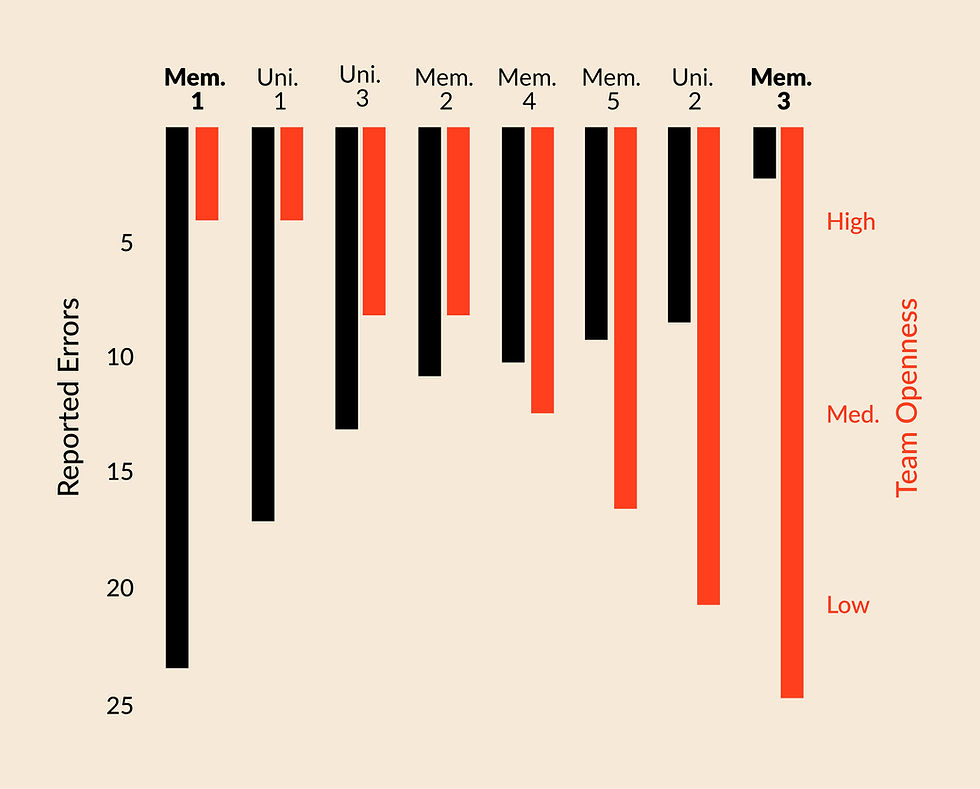
The two units in the story were Memorial 1 and Memorial 3 - at either end of the chart.
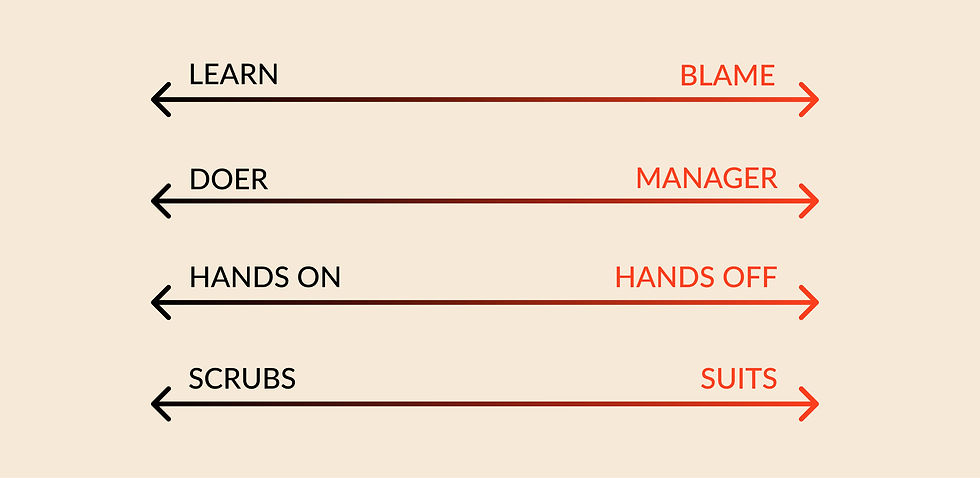
It's also interesting to compare how the team and manager characteristics scaled across those eight units:
Permission For Candor
Administering drugs in hospitals is a complex and tightly-coupled system.
For each dose there are ten places an error can occur, through a chain of five people from doctors, to administrators and nurses. [3]
There are a lot of opportunities for human error.
In complex situations, where people can easily make situational and subtle mistakes, team openness is essential to reducing error.
It's true in nursing, but in any other complex environment too.
Edmondson calls this optimum working environment “team psychological safety”.
“For knowledge work to flourish, the workplace must be one where people feel able to share their knowledge! This means sharing concerns, questions, mistakes, and half-formed ideas.” [2]
The team has to have the shared belief that they can take risks, present ideas, highlight concerns, or admit mistakes, without the fear of negative consequences.
“With routine, predictable, modular work on the decline, more and more of the tasks that people do require judgment, coping with uncertainty, suggesting new ideas, and coordinating and communicating with others. This means that voice is mission critical. And so, for anything but the most independent or routine work, psychological safety is intimately tied to freeing people up to pursue excellence.”
“When a work environment has reasonably high psychological safety, good things happen: mistakes are reported quickly so that prompt corrective action can be taken; seamless coordination across groups or departments is enabled, and potentially game-changing ideas for innovation are shared. In short, psychological safety is a crucial source of value creation in organizations operating in a complex, changing environment.” [2]
“Create a culture in which it is okay to make mistakes and unacceptable not to learn from them.” - Ray Dalio [4]
Safety & Accountability
Psychological safety isn't about being nice.
An environment where people are ok with mistakes happening, without a drive to learn and improve, is a failing environment.
It’s essential that there is also accountability.
As Amy Edmonson says, “In any challenging industry setting, leaders have two vital tasks. One, they must build psychological safety to spur learning and avoid preventable failures; two, they must set high standards and inspire and enable people to reach them.” [2]
In 2015 Google wanted to identify the patterns and behaviours that enabled some of their teams to be high performers.
They studied 180 teams over two years, examining 250 different team attributes. [5]
They identified five main attributes that all the high performing teams shared and they ranked them by their influence:
Psychological safety - They feel safe to take risks and be vulnerable.
Dependability - They get things done on time to a high level of excellence.
Structure and Clarity - They have clear roles, plans and goals.
Meaning - They find their work personally important.
Impact - They believe their work matters and creates change.
As Julia Rozovsky, the leader of that study puts it, “psychological safety was by far the most important.” [3]
And second on the list is accountability.

A Wise Man Once Said
The Google research project was called ‘Aristotle’ after a quote often attributed to him; “the whole is greater than the sum of its parts.”
Psychological safety allows everyone in a team to work at their best.
The cumulative effort of everyone starving effectively towards shared goals really adds up.
“Pleasure in the job puts perfection in the work.” - Aristotle
This story is also a reminder to make sure you are not just operating on superficial and short-term metrics.
I’ve seen numerous sales teams that look great on paper for a short while, under stress or through directorial management, only for the results to plummet in the longer-term without psychological safety.
Always dig deeper.
“Excellence is never an accident. It is always the result of high intention, sincere effort, and intelligent execution; it represents the wise choice of many alternatives - choice, not chance, determines your destiny.” - Aristotle
[1] Edmondson,A., “Learning From Mistakes is Easier Said than Done: Group and Organisation Influences on the Detection and Correction of Human Error”, Journal of Applied Behavioral Science (2004)
[2] Edmondson,A., “The Fearless Organization: Creating Psychological Safety in the Workplace for Learning, Innovation, and Growth”, Wiley (2018)
[3] Bates, D. W., Leape, L. L., Patrycki, S., “Incidence and preventability of adverse drug events in hospitalized patients”, Journal of General Internal Medicine (1993)
[4] Dalio, R., “Principles: Life and Work”, Simon & Schuster (2017)
[5] “Understand team effectiveness”, Google re:Work (2015)


