
The Outcome

In October 1976, as a torrential rainstorm pummeled the Fuji Speedway in Japan, the Formula 1 World Championship all came down to a single decision.
Niki Lauda, the reigning champion and Ferrari’s lead driver, was a talented and immensely disciplined racer nicknamed ‘The Computer’.
Unusually for a driver, Lauda was heavily involved in the technical development of his cars, constantly calculating ways to tilt the odds in his favour.
His main rival, James Hunt, or ‘Hunt the Shunt’, was a very different character, a hard charging, charismatic playboy, infamous for wearing a "Sex, Breakfast of Champions" patch on his racing suit, who relied on raw instinct and aggression, to either win, or crash spectacularly in the attempt.
Half way through the season, while comfortably leading the Championship with twice as many points as any other driver, Lauda suffered a horrific crash at the dangerous Nürburgring circuit in Germany (a track that had previously claimed the lives of five Formula 1 drivers).
Trapped in an 800°C inferno with a broken wrist, he suffered first degree burns across his head and hands while superheated toxic gases scorched his lungs.
He had to be pulled from the wreckage by four fellow drivers who stopped to save his life.
At the hospital, a priest read him his last rites.
But, just 42 days later, with blood still oozing from his substantial burns and sticking inside his helmet, he returned to race in Italy to defend his title.
During Lauda's recovery, Hunt picked up enough wins and points to claw himself back to within three of points of the leader with just one race to go.

With a monsoon hitting the final race in Japan, and struggling to see anything due to the damage to his eyelids, Lauda had to make a huge decision.
After just one lap, he pulled into the pits and stepped out of the car.
He felt that racing in these conditions was just too big a risk to his life.
Many of the journalists and commentators accused him of losing his nerve and surrendering the title.
Meanwhile James Hunt was willing to take the risk and raced on.
Battling severe tyre issues he overtook two other drivers in the final few laps to claim third place, beating Lauda to the World Championship title by a single point.
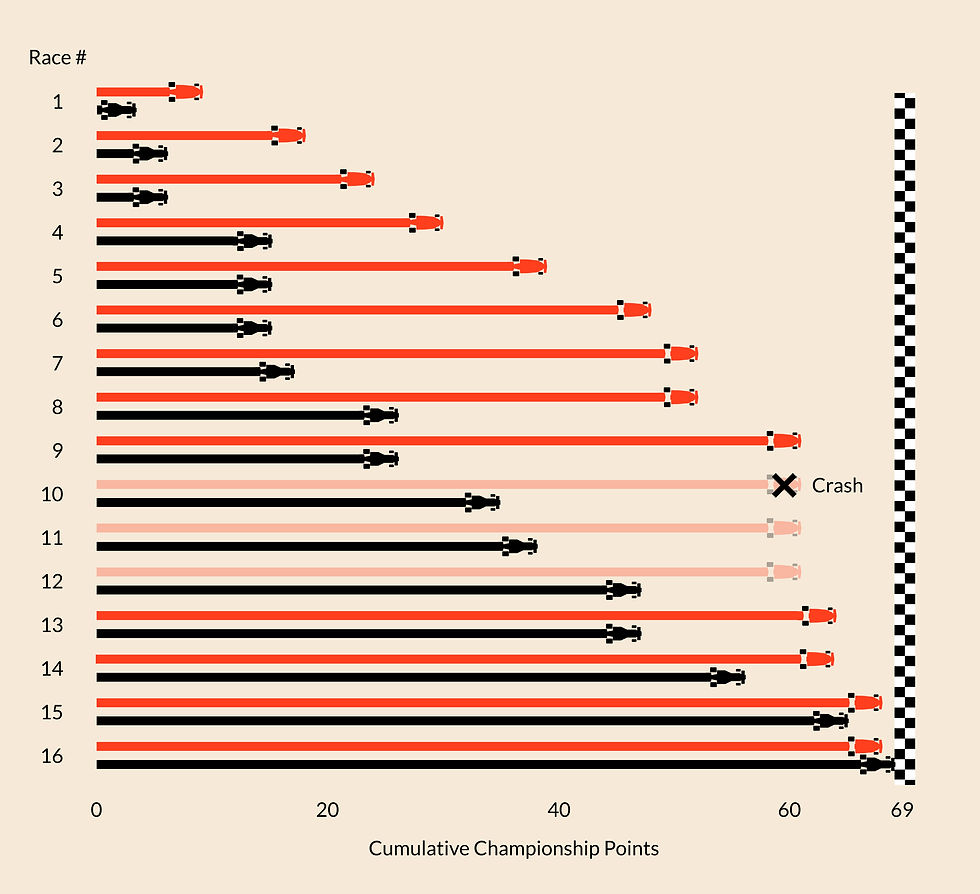
It was a fairytale ending for the underdog and it was the storyline that kick-started Formula 1’s current global popularity.
Outcomes & Hindsight
The problem with this story is if you judge that season just by who won, you learn completely the wrong lesson.
We naturally evaluate the quality of decisions based on the outcome.
Great result? We assume great decisions were made.
Bad result? We assume mistakes were made.
But sometimes we win or lose because of factors we can't control (good or bad luck), regardless of the decisions we made, but we struggle to account for this.
Psychologists call this Outcome Bias.
It was first described by the researchers Jonathan Baron and John Hershey who showed that when people were given identical information, they rated the decision-maker as "smart and competent" if the patient survived, but "irresponsible and negligent" if the patient died, even though the decision process and statistical odds were identical.
On top of that we also tend to look back at things and think they were far more predictable than they really were.
This is called Hindsight Bias, or the "I-knew-it-all-along" effect.
Hindsight bias leads us to look back at Lauda’s narrow loss and see it as the inevitable result of his choice, while ignoring the huge risks present at the time.
It also leads us to ignore how unlikely Hunt’s victory was.
Hunt had to finish at least third without crashing, which was a huge factor for a driver who failed to finish half the races in his career.
The Decision-Outcome Matrix
To test choices, you have to separate the quality of the decision from the outcome.
It can be shown as a matrix:

Deserved Success (Good Decision + Good Outcomes) is the ideal repeatable process.
Bad Luck (Good Decision + Bad Outcomes) is what happened to Lauda when randomness struck. He made all the right decisions and still lost. If this happens to us we have to stay the course.
Dumb Luck (Bad Decision + Good Outcome) is the most dangerous place to be because we struggle to see the difference between this and deserved success. James Hunt won primarily because Lauda’s bad luck was his good luck. You can temporarily get away with a flawed approach, but if you continue or double down on a process like this you risk dramatic failure.
Deserved Failure (Bad Decision + Bad Outcome) is a great process to chuck away immediately.
Leading not Lagging
Because the results lag behind the decisions that produce them, and our brains are keen to muddy the waters, to successfully evaluate processes we need to track leading indicators.
If you’re running a commercial team the actual sales are a lagging outcome.
It tells you nothing about whether those sales were the result of a repeatable strategy or just a lucky month with a big client walking in the door.
To build a reliable process you have to track indicators like:
The number of prospect contacts added, emails sent, and calls completed will show if your activity levels are good.
Conversion rates into meetings and proposals allows you to optimise those activities.
The sales people with more and higher-quality activity in their funnel will be the best sales people in the long-term.
If you look back at 1976, beyond the lagging outcome (the final standings) and track the leading indicators, Lauda was miles ahead.
Car Preparation
To have the best chance of winning a car race, have the best car.
The driver who spends the most and highest-quality time testing and optimising the set-up of their cars has the best chance of winning.
Lauda worked relentlessly with his engineers on this.
Hunt preferred to rock up on the day and rely on driving instinct.
Driver Health
Formula 1 is a grueling test of physical stamina.
Lauda hired Willi Dungl, a pioneer in sports medicine and physiotherapy, to manage his diet, hydration, and physical preparation.
Hunt was fueled by alcohol, smoking, and parties.
Racing Experience
More experienced drivers are faster and better able to avoid problems.
Niki Lauda competed in 173 Formula 1 races.
Almost twice Hunt’s 92.
Race Reliability
To finish first, first you have to finish.
Through better preparation and controlled driving Lauda had a good record of completing races at a time when that was still a major challenge in the sport.
Between 1975 and 77 he retired from just 14% of his races, winning 31%.
Across the same time Hunt won 11% of his races and retired from 50%!
The Long-Term Game
James Hunt’s success was unsustainable.
He celebrated his championship with a months-long bender, won only a handful more races, and retired from F1 just three years later without winning another title.
In 1977 Niki Lauda returned to dominate the field and win his second World Championships.
Then seven years later, after taking a sabbatical to launch his own airline, he came back and won again in 1984 with a different team.
Later still the same mindset landed him the role as the Chairman of the Mercedes F1 team, where he recruited Lewis Hamilton and helped build the disciplined organisation that delivered eight consecutive World Constructors' Championships.
"From success, you learn absolutely nothing. From failure and setbacks, conclusions can be drawn." - Niki Lauda
McChesney, C., Covey, S. and Huling, J., “The 4 Disciplines of Execution: Achieving Your Wildly Important Goals”, Free Press (2012)
Russo, J. E., Schoemaker, P. J. H., “Decision Traps: The Ten Barriers to Brilliant Decision-Making and How to Overcome Them”, Doubleday (1989) & “Winning Decisions: Getting It Right the First Time”, Currency/Doubleday (2002)
Baron, J., Hershey, J. C., "Outcome Bias in Decision Evaluation", Journal of Personality and Social Psychology (1988)
Fischhoff, B., "Hindsight is Not Equal to Foresight: The Effect of Outcome Knowledge on Judgment Under Uncertainty", Journal of Experimental Psychology: Human Perception and Performance (1975)
Lauda, N., “To Hell and Back: An Autobiography”, Stanley Paul & Co. (1986)