
Are You Getting Worse With Experience?

The more experienced you become, the better you are at your job.
It’s common sense.
Except...
You might not be improving at all.
You could actually be getting worse, and you have no idea it's happening.
The Experience Paradox
A huge research study across 700,000 patients, treated by 19,000 physicians, discovered that the more experience a doctor had, the higher the chance that their patients would die:
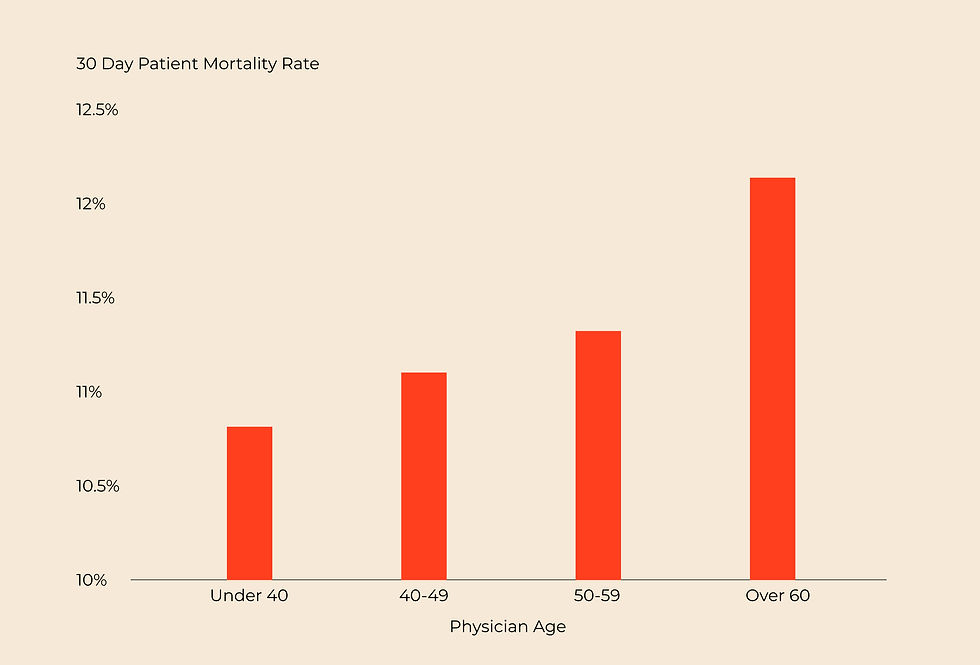
Physicians reach their peak performance in the few years after they’ve finished their residency - an intensive period of specialist training and continuous feedback at the start of their career.
But over time the physicians’ clinical knowledge drifts and adherence with up-to-date standards slowly falls.
They believe they are improving through decades of practice
But they are actually getting worse.
And a major factor in this is feedback, or that lack of it.
The quality and volume of feedback a physician receives after their residency falls off a cliff.
Kind & Wicked Learning Environments
To understand why experience can trick us, we have to look at how learning happens.
Some tasks are ideal for providing valuable feedback, allowing you to rapidly improve.
Learning how to ride a bike is a good example.
As you wobble along you receive a constant stream of feedback, so if you start to lose your balance you can immediately react and learn.
And once you’ve learned to ride a bike, doing it again in the future is … like riding a bike.
Behavioural scientists Robin Hogarth and Emre Soyer call this a ‘kind learning environment’.
Kind learning environments provide immediate, accurate, and abundant feedback, and the rules stay consistent, so the lessons gained from experience are reliable.
The more you do, the better you get.
Unfortunately life, work and business are rarely like this.
We’re exposed to more complex situations with many contributing factors, filters and distortions.
Results come with considerable delay, so it’s easy to misinterpret them, or be misled, and there’s no guarantee that the lessons are reliable.
Hogarth and Soyer call these ‘wicked learning environments’.
Doing more doesn’t necessarily mean getting better.

Physicians operate in wicked environments.
After treating a patient they have very little to do with the outcomes (the nursing and recuperation).The feedback they do get is slow and not detailed enough to learn from.
To make things worse, wicked environments frequently appear to be kind ones.
They create a false sense of mastery, convincing us we’ve learned the right lessons when we've actually drawn the wrong conclusions.
In 1861, Hungarian physician Ignaz Semmelweis proved that handwashing dramatically reduced patient mortality rates in hospitals, but it took another 30 years before it was adopted by other doctors!
For an entire generation of time, the majority of doctors remained convinced that handwashing was not needed, because their wicked feedback loops kept them blind to the consequences of their actions.
“Men stumble over the truth from time to time but most pick themselves up and hurry off as if nothing has happened.” - Winston Churchill
Semmelweis was ostracised, had a mental breakdown and died in obscurity, after being physically abused in a metal asylum. (Another great reason for being glad we weren’t born in the nineteenth century)
Hundreds of thousands of people died as a result of ignoring Semmelweis’ insight.
Hundreds of thousands are still being affected by poor feedback loops in healthcare.
Taming a Wicked Learning Environment
You’re not doomed to fail in a wicked environment, but you do need to actively pursue better feedback.
Commercial air travel is a wicked environment.
But despite this challenge commercial flight has become increasingly safe:

The air industry has managed to learn and improve, successfully counteracting the wicked learning environment they operate in.
They've done that by collectively working to significantly increase the quality of feedback and their ability to learn.
Any time an airliner crashes there is a thorough and open investigation to understand exactly what happened, and safety recommendations are implemented across the world to prevent similar incidents happening in the future.
Air travel is now the safest form of travel.
Building a Feedback Engine
You are almost certainly operating in a wicked learning environment.
For any person or business that wants to improve in a wicked learning environment you have to deliberately increase the volume, accuracy and immediacy of your feedback.
This challenge was the core motivation behind Yumpingo, a feedback service for restaurants that I was a cofounder.
Hospitality is another classic wicked learning environment.
Traditional feedback options, like the odd mystery diners, ignored long-form surveys, or emotional surface-level online reviews all produced partial and misleading feedback
By presenting flawed data as actionable truth, these tools trick restaurant operators into making bad strategic decisions.
To unlock real improvement, feedback has to have three core criteria:
Accurate - Free from extreme bias or small sample sizes.
Granular - Tied directly to specific products, teams, or moments in time.
Recent - Delivered near real-time so adjustments can be made immediately.
By sourcing this high-quality actionable feedback, hospitality brands transformed guest satisfaction and profitability, and aviation saved millions of lives .
If you foster your own personal feedback loop you have a great advantage in work and life.
Experience is only the engine of growth if good feedback fuels it.
“Feedback is the breakfast of champions.” - Ken Blanchard
Tsugawa, Y., Blumenthal, D. M., Newhouse, J. P., Zaslavsky, A. M., Jena, A. B., “Do Doctors Get Worse as They Get Older?”, Harvard Business Review (2017)
Hogarth, R., Soyer, E., “The Myth of Experience: Learning the right lessons to improve decisions”, PublicAffairs (2020)


